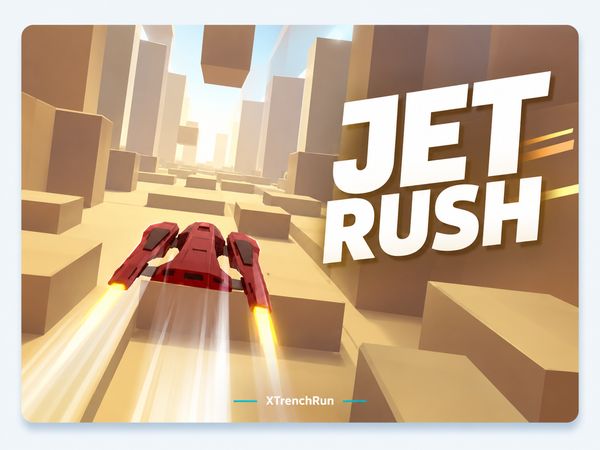
Jet Rush throws a jet into dense geometric corridors where every left or right move must land on time. The speed creates pressure immediately. Urban structures and moving platforms close off safe space in seconds, so clean reactions matter more than elaborate plans.
This single-player arcade flight runner runs in a Unity WebGL browser build. Use the Arrow Keys to steer left and right. On mobile, tap to play. Press the Space Bar to confirm a selection before a run.
Learn the lane shapes, keep your inputs controlled, and turn short flights into better attempts. Play Jet Rush online here and test your reflexes now.
Flight Fundamentals and Core Movement
Autonomous Acceleration Dynamics
Jet Rush keeps the flight focused on momentum and reaction. Your jet pushes through the course while obstacles arrive quickly. That creates a simple but demanding job: read the next opening and steer before it disappears.
Start by treating the center of the screen as a guide, not a permanent home. A central line gives room to answer hazards from either side. Still, do not cling to it when a structure blocks the route. Move early enough to claim open space.
Each run rewards attention over panic. Watch the corridor ahead, then pick one direction with purpose. Late inputs leave little room for correction. Early recognition gives you time to guide the craft through a safer lane.
The arcade feel comes from immediate responses. You do not need complex commands to make progress. You need steady awareness as the flight carries you forward through each dense section.
Lateral Steering and Micro-Adjustments
Use the Arrow Keys to steer the jet left and right. Keep taps brief when you only need to shift a small amount. Long holds work better when the route clearly opens across a wider lane.
Make one correction, then reassess. Repeated direction changes can pull the jet away from the line you intended. Let the craft settle after a move. That short pause helps you judge the next obstacle accurately.
On mobile, tap to play before starting. Once the run begins, keep your attention on the corridor rather than the interface. The course demands quick visual decisions.
Navigating Dynamic Obstacles and Cityscapes
Reading Moving Obstacles and Platforms
Moving platforms change the route as you approach them. Do not judge them from one glance. Watch their position long enough to see which side offers space. Then steer toward the clearer path before the gap tightens.
Urban structures create strong visual edges. Use those edges to map the corridor ahead. A wide wall may force a full lane change, while a smaller shape may only require a measured nudge. Match the size of your input to the space you need.
Look beyond the nearest obstacle whenever possible. The first opening may lead straight into another blocked area. A better route often appears when you trace two hazards in sequence. This habit turns rushed reactions into deliberate choices.
Keep your jet in open air after a dodge. Avoid drifting close to a structure just because you cleared its first edge. Moving platforms can change the available space fast, and extra room gives you more options.
Threading Narrow Gaps and Passages
Narrow passages test your timing more than your courage. Line up before you reach the entrance. A late sideways move can place the jet against the passage edge.
Pick a clean route through the middle when the space allows it. That leaves room for a small correction if the view changes. When one side clearly gives more clearance, commit to that side instead.
Do not turn sharply after entering. Hold a calm line until the jet exits the tight section. The next hazard deserves your full attention.
Mastering Scoring and Risky Flight Paths in Jet Rush
Collecting Credits on Tight Angles
A strong score run starts with a strong survival line. Distance only grows while your flight continues, so treat every tight angle as a choice between clean progress and unnecessary danger. The safest path often supports the best long-term result.
Use wide openings to reset your position. A centered jet can react to the next obstacle from either side. If the course presents a narrow route, guide the craft into place before the final moment. That protects the run from a rushed turn.
Watch how each corridor connects to the next. A line that looks direct may leave the jet trapped near an urban structure. A slightly wider route can preserve momentum and create a better view ahead.
Build consistency first. Short, controlled flights teach more than reckless attempts.
Balancing Survival Against Greed
Do not chase every difficult line. A flight ends on collision, so survival must lead each decision. Choose room to steer when the route becomes crowded.
Risk makes sense only when you already see the exit. If a path forces blind movement, return to a safer lane. Clean runs create more chances to improve a high score.
Try Jet Rush right here, then focus on finishing each difficult section with control.
Collision Mechanics and Run Termination
Instant Impact Outcomes
Jet Rush uses zero-tolerance collision rules. Contact with urban structures, moving platforms, or other course obstacles ends the flight. There is no room to scrape an edge and recover, so keep a visible margin around the jet.
Respect the full shape of each hazard. Clearing one corner does not guarantee safety from its next edge. Continue steering until the craft has passed the obstacle completely. Then return to a useful position for the route ahead.
Most crashes begin before the final impact. A rushed turn, a missed opening, or an overcorrection puts the jet on a bad line. Notice that earlier mistake after every run. It gives you a practical fix for the next attempt.
Stay calm after a close call. Sudden extra inputs often create the collision you were trying to avoid. Let the cleared space appear before making another move.
Resetting and Refining Trajectories
Instant restarts let you test a new trajectory without delay. Use that speed to practice one problem area at a time. Change the timing of your first turn, not every part of the run.
Repeat the opening with a clear goal. Enter a gap earlier, leave more space from a platform, or stop correcting twice. Small changes make improvement easier to spot.
Press the Space Bar to confirm a selection when needed, then restart with a calmer plan.
Reflex Drills for High-Speed Jet Rush Survival
Focal Distance and Anticipation
Keep your eyes ahead of the jet, not fixed on its nose. The near screen shows the immediate threat, but the farther corridor shows what your next move must prepare for. Split your attention between both distances.
Practice spotting the widest available lane first. This gives your brain a simple target during fast sections. Next, check whether that lane stays open after the first obstacle. A route only helps if it leads somewhere safe.
Use short runs as visual drills. Name the next opening in your head, then steer toward it. This builds anticipation without adding extra control pressure.
Smooth Input Versus Oversteering
Steer with purpose, then release the direction. Smooth input keeps the jet closer to your planned line. Fast back-and-forth presses waste precious space.
Save larger turns for clear lane changes. Use smaller corrections near tight passages. That balance keeps your flight stable when the course becomes crowded.
Start another run here and put those calmer inputs to work.
Compare with Similar Games
| Game |
Why Similar |
| Cubic Rush |
Shares the core mechanic of continuous forward flight where the player steers laterally to dodge static geometric obstacles in an endless survival run. |
How to Play Jet Rush
Step 1: Launch the Game
Press the Space Bar or tap the screen to clear the title menu and initialize your jet on the runway.
Step 2: Steer Around Immediate Hazards
Use the Left and Right Arrow Keys to guide your jet around the opening pillars and static walls.
Step 3: Anticipate Dynamic Hazards
Watch the horizon to spot rising platforms and shifting passages before your accelerating craft arrives.
Step 4: Restart to Beat Your Best Distance
When a collision occurs, review your final score and start a fresh run to practice cleaner lines.
Jet Rush FAQs
What are the basic controls for Jet Rush?
Browser keyboard: Arrow Keys — steer; Space Bar — confirm selection. Mobile: Tap — tap to play.
Can I play Jet Rush on mobile devices?
Yes. Jet Rush runs in your phone or tablet browser, and it has touch controls. There is also a mobile app.
Do I need to download Jet Rush?
No. Jet Rush runs in your browser on this page, with nothing to download or install.
What happens when you hit an obstacle in Jet Rush?
Any direct collision with a building, barrier, or moving platform instantly destroys your aircraft. The run terminates on impact, showing your final score and offering an immediate restart.
Conclusion
Jet Rush delivers a focused Arcade Flight Runner experience built for quick, accessible play. Its single-player format keeps the action centered on your control, whether you are playing in a browser or on mobile.
Use the Arrow Keys to steer and the Space Bar to confirm selections, or tap to play on mobile. With Unity WebGL support and straightforward controls, Jet Rush is easy to start whenever you are ready. Play Jet Rush right here on this page.

No comments yet. Be the first to share your thoughts!